An effective executive briefing is one of the clearest signs that you are operating as a strategic EA rather than simply keeping things moving. As EAs, we sit close enough to the detail to understand what has happened while our Executive was on a flight, what has built up in their inbox over the course of a day, which conversations have moved forward, and which issues are quietly waiting for a decision. Sometimes that briefing supports a meeting, but just as often it is about bringing them up to speed after travel, summarising a chain of emails, or clarifying what actually needs their attention versus what can move without them.
When your Executive steps into any situation without that clarity, whether that is a leadership call, a board discussion, or simply opening their inbox after being offline, the impact is immediate. Questions surface that could have been anticipated, priorities start to blur, and instead of moving a decision forward the conversation circles back to context that should already have been clear. Those moments add up. At mid to senior level, building an effective executive brief becomes part of how we protect our Executive’s credibility and help them focus their energy where it matters most.
In this article, we will explore what makes an effective executive brief in practical terms, grounded in how our days actually run. We will look at a structure you can rely on, how to apply it across daily updates, weekly rhythms and quarterly planning, and how to prepare your Executive for scrutiny without overwhelming them with unnecessary detail. We will also cover follow-up, because clarity after a conversation or decision point is often where the real discipline sits.
If you want your Executive to move through their day clear on what requires a decision, confident in the recommendation you are putting forward, and aware of the risks or sensitivities attached, this skill is worth refining. As EAs, this is where our contribution shifts in how it is perceived, because we are helping shape thinking and direction rather than simply coordinating the logistics around it.
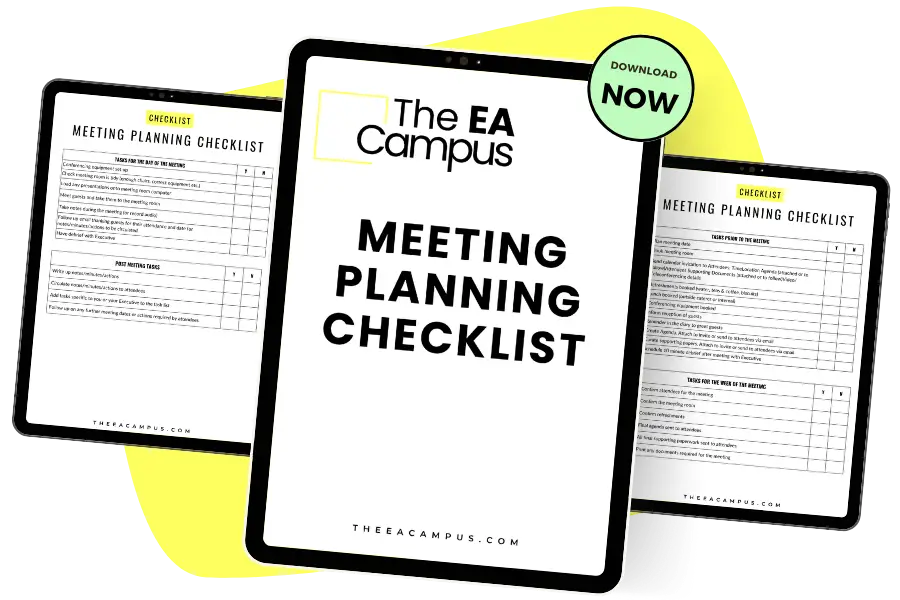
Use this template to quickly and effectively plan any meeting.
Ensure that every meeting is planned meticulously and that your Executive is prepared for every meeting they attend with our free Meeting Planning Template for Executive Assistants.
Why Executive Briefing Is a Strategic Skill for EAs
As your role grows and your Executive trusts you with more context, you should use the opportunity to brief your Executive beyond just passing on information and actually start to look at what impact the information is having on how decisions are made.
Yes, the document needs to be clear and structured, but what matters more is the thinking behind it. As EAs, we are constantly deciding what actually needs our Executive’s attention, what can move without them, and how to present a recommendation so they can respond quickly without having to reconstruct the backstory themselves.
You will recognise the moments when that thinking has not happened. Your Executive joins a call after travel and spends the first ten minutes asking what has changed because no one sent a tight summary setting out detailing what has happened, what is needed, and what’s been recommended. They open their inbox after being offline, and there is no short note separating the decision required, for awareness, and they can move without you, so they work it out line by line. A paper goes to a leadership group with pages of background, but no clear recommendation at the top, and the discussion drifts because no one has stated the direction. In each case, the issue is not the volume of information. It is that the brief did not clearly set out the decision, the recommendation, and the next step.
This is why we need to treat briefing as an ongoing practice rather than something we only do before a big meeting. It runs through inbox summaries, travel catch-ups, project updates, and board preparation. It affects how we gather context, how we filter it, how we draft a covering note, and how we confirm decisions afterwards. When we approach it consistently, the quality of the conversations our Executive has improves straight away.
The 30-Second Rule for Executive Briefings
One simple way to sense-check any brief is the 30-second rule. If you had half a minute of your Executive’s attention in the corridor, what would you say? What must they leave from that exchange remembering? In practice, that usually comes down to three things:
- Start with your recommendation. Say clearly what you think should happen so your Executive is not searching for the point.
- State the decision required. Be explicit about what you need from them, whether that is approval, input, or a steer.
- Explain why this matters now. Make the timing and the consequence of delay clear so they understand the context for the decision.
If those three elements feel fuzzy when you say them out loud, the brief needs tightening. When they are clear, your Executive can step into a board discussion, open their inbox after a long day, or pick up the phone to a stakeholder already aligned with the direction.
The Core Structure of a High-Impact Executive Brief
Before we get into structure, it helps to step back and look at two concepts that often get referenced around briefing documents. These terms are usually applied in project management, but will help you think about howyou brief your Executive.
The Pyramid Principle
The Pyramid Principle is really simple. You start with the main message first, then support it with grouped reasons or evidence underneath. So instead of building up to your point through background, you state the answer up front and then explain why. Senior leaders tend to think this way naturally. They want the conclusion first, then the supporting logic. As EAs, this is good to use in a brief, because if we bury the recommendation on page two, our Executive has to work to find it.
Context, Question, Conclusion
Context, Question, Conclusion, or CQC, is another way of structuring thinking. First, set the context. Then clarify the question or decision that needs to be addressed. Finally, state the conclusion or recommendation. You will recognise this pattern in strong board papers and investment memos. It keeps everyone focused on what is actually being decided rather than drifting through the background.
Neither of these models is complicated, and you do not need formal training in them to use the logic. What we do need, as EAs, is a structure that works for you. That might be a written brief, a covering email before your Executive lands from a trip, or a two-minute verbal update between calls. Most of us have briefed our Executive before. The shift here is adding more discipline and consistency to how we do it.
Another part to consider when preparing an executive brief is how your Executive will consume it. Are they reading it on their phone between meetings? Are they asking for a quick summary while walking to a lift? Are they likely to forward it straight to a stakeholder? That practical reality should shape the structure. Let’s look at an example of a framework adapted specifically for EAs.
Executive Brief Framework for EAs
- Firstly, your Exec needs context. Set out clearly what has happened and why you are briefing your Executive now. This could be an escalated issue from a direct report, some news that needs to be passed on that developed while they were travelling, or a deadline that has moved forward. If you cannot explain the context in a few focused sentences, there is probably too much background included.
- Next, your Exec needs to know what is required of them. Be explicit about what you need. Approval to proceed. A steer on direction. A final sign-off. Input before something goes external. Do not assume it is obvious. Write it in a way that your Executive could reply with a clear yes, no, or instruction.
- This is where you become really useful. If you can, make a recommendation. State what you believe should happen. As EAs, we often hold more context than anyone else in the thread. Use that perspective. Your recommendation does not need to be long, but it should be clear enough that your Executive understands your thinking immediately. Include the key reasons that support your recommendation. Limit this to what genuinely strengthens the case if you really want them to go with your choice. Saying that, if there are five pages of data behind your recommendation, summarise the two or three points that matter most.
- If there are any risks or any other challenges your Eec should be aware of it include that detail. Flag risks, stakeholder sensitivities, budget constraints, timing issues, or office politics type considerations. If you expect pushback from a particular person or team, name that risk and explain why.
- Mention what happens after the decision has been made, follow-up needs to take place. Who communicates it? Who implements it? What the timeline looks like. This prevents the follow-up confusion that many of us have experienced after a fast-moving discussion.
In written form, this brief usually fits into one to two pages, and often much less. In a verbal brief, it should flow naturally through those same points without circling back. If we cannot explain it clearly in that structure, that is often a signal that our own thinking needs tightening before it reaches our Executive. Obviously, if it is a conversation, you can write down your talking points before we go ahead and talk with your Executive.
Using Executive Briefings Across Your Yearly Cadence
As EAs, we know that briefing your Executive rarely happens in one formal slot. It happens in small windows, then stretches into our weekly one‑to‑one, monthly reporting, and quarterly prep. If we think about the natural rhythm of our Executives’ time, it becomes much easier to decide what information belongs where and how to present it so they can absorb it quickly.
At its simplest, our job is to move useful information from the wider business to our Executive in a way that makes sense. That might be a quick verbal update between meetings, a short email before they land from a flight, or a structured document ahead of a board session. The format of the briefing will change depending on the scenario, but the structure will stay the same.
Daily Executive Brief
Most days should start with a short sync or at least a moment to connect with each other. Sometimes it will be ten minutes in the office, or it will be a voice note or a message before their first call. Whatever the format, this is where we set the tone for the day. In that daily window, you should cover:
- What has changed since they were last online or last updated?
- What in the inbox genuinely requires a response today
- Which meetings need preparation beyond simply turning up?
- What they need to be aware of, but do not need to act on yet.
Now the bulk of the work happens before that conversation takes place. Keep the work pretty focused so the brief doesn’t take up too much time. So, email threads get scanned, Slack or Teams checked, decks and agendas reviewed, and then you can pause to ask yourself, if I only had five minutes with my Executive right now, what would I say first?
AI tools can help with the volume, but they do not replace your filter.
In Outlook, Copilot can summarise a long email thread into a short paragraph. From there, we edit it down into a three‑line note that clearly states what changed and what is needed. In Gmail or Google Docs, Gemini can pull out unresolved comments from a shared document, so we don’t have to read 20 replies to find the one open question.
In ChatGPT, we can paste in scattered updates from different teams and ask for a structured output, such as:
- Key updates
- Open points
- Decisions required
Then we refine it in our own words before it reaches our Executive.
A daily written brief might look like this:
Subject: Today’s Key Points
- 2pm Supplier Call. Decision required between option A and B. Finance prefer A due to cost. Legal have cleared both.
- HR Escalation received yesterday. Summary below. No action today, but Comms need your steer by Thursday.
- Board Paper updated. Only change since last version is the revised forecast on page 4.
If your Executive prefers a verbal update, the same structure applies, and as we said, you can write this out so you know your talking points ahead of the conversation. Keeping that rhythm prevents the conversation from drifting into background detail that does not help them move forward.
Post‑Meeting Debriefs
Meeting debriefs can absolutely be included in running effective Executive briefings. Sometimes you’ll be in the meeting and sometimes you are picking up the detail straight afterwards. Either way, once a decision has been made or direction has been given, othe briefing work starts. For example:
- Capture decisions as soon as you hear them, whether that is live in the room or during a debrief with your Executive.
- If your Executive takes their own notes, ask to see them straight away. Even a quick photo of handwritten notes can be useful. With the right privacy boundaries in place, you can drop those notes into ChatGPT or Copilot and ask for a short summary of decisions and actions, then edit it before sending anything on.
- Confirm actions and owners, either directly with colleagues if you were present, or by clarifying with your Executive before anything is communicated.
- Send a short recap where needed so everyone is working from the same version of the decision.
- Update any collaboration tools or action lists the same day so nothing relies on memory or assumptions.
Most of us have experienced a decision being interpreted in three different ways by the end of a week full of long meetings. A short, clear follow‑up note after each one, even drafted with the help of AI and then refined by you, keeps everyone aligned on what was actually agreed.
Weekly Executive Brief
The weekly Executive brief should ideally happen during your one‑to‑one meeting with your Executive. And this is where you can go into a little more detail. Instead of focusing on individual emails, for example, you can step back and look at the flow and priorities for the week ahead. In your one-to-one, it can help to cover:
- The three to five priorities that define success this week.
- Meetings that directly connect to monthly goals or board commitments.
- Deadlines that need preparation time in the diary.
- Areas where the calendar and stated priorities do not match.
This is also a really good opportunity to use AI tools more structurally. Copilot can generate a summary of all meetings scheduled that week, which we can then scan for themes or duplication. And/or, ChatGPT can turn a rough list of tasks into a structured weekly overview that separates strategic work from operational admin. In terms of format, you might create a briefing document that looks like this:
- Weekly Focus – Three priorities
- Preparation Required – Meetings needing pre‑reads or talking points
- Deadlines – Items due this week
- For Awareness – Items progressing but not requiring action
Monthly Executive Brief
The monthly briefing then becomes about consolidating all of the information you’ve pulled together. As EAs, we gather updates from different teams and, in these briefing documents, turn them into something our Executive can scan in minutes rather than hours. Along with an overview of everything you’ve pulled together, you could also include updates from direct reports in a consistent three‑question format. You could then use AI to summarise those updates into one page and extract only what has changed since last month. Additionaly you could maintain a rolling document so each month builds on the last.
A monthly brief might include:
- Initiative updates in three lines each.
- Budget or headcount changes since the previous report.
- Key commitments next month that require time or preparation.
- Decisions that need to be scheduled into the diary.
Quarterly Executive Brief
Quarterly work often feels bigger, but the structure is similar. At this level, we are pulling themes rather than individual updates.
- A consolidated summary of key updates from each function, reduced to what your Executive actually needs to know.
- Alignment across board packs, slide decks, and briefing notes so the messaging and numbers match before anything goes out.
- Forward planning for major commitments, ensuring prep time, draft reviews, and stakeholder check‑ins are blocked in the diary.
- A practical quarterly checklist covering reporting deadlines, board submissions, compliance tasks, and recurring stakeholder updates.
AI, again, can support this by comparing this quarter’s updates with the last and flagging differences, summarising long board packs into a short internal note, or drafting first versions of recurring sections that we then edit.
If this has resonated, it is probably because you already brief your Executive in some form. The difference at a more senior level is consistency, structure and confidence in how you move information across the business. As EAs, that shift happens when we stop reacting to what lands in our inbox and start managing the flow of information deliberately across the day, week, month and quarter.
Working at that level does not require a new title. It requires clearer thinking, stronger communication and a deeper understanding of how your Executive operates. When you can summarise complexity in a few lines, structure updates without being prompted, and use tools like Copilot or ChatGPT to reduce manual effort while keeping ownership of the message, your role naturally expands.
If you would like to develop that capability further, the Strategic Business Partner Online Course goes deeper into how to operate confidently at a senior level, strengthen your working relationship with your Executive, and position yourself as a true partner in the business.